Free shipping on orders over $100


How Allulose Works in the Body
Posted by William Lang on Apr 06 2026
How Allulose Works in the Body: A Scientific Breakdown
An exploration of the metabolic pathways, enzymatic inhibition, and physiological impact of D-Psicose.
The Evolution of Sweetness
For decades, the search for a non-nutritive sweetener that mimics the functional properties of sucrose has been the “Holy Grail” of food science. Enter Allulose (D-psicose), a rare sugar that occurs naturally in wheat, figs, and raisins, but only in trace amounts. Unlike synthetic sweeteners or sugar alcohols, allulose is a monosaccharide, meaning it is chemically a sugar, yet it behaves in the body in a way that defies traditional carbohydrate metabolism.
1. The Molecular “Glitch”: Why it Works
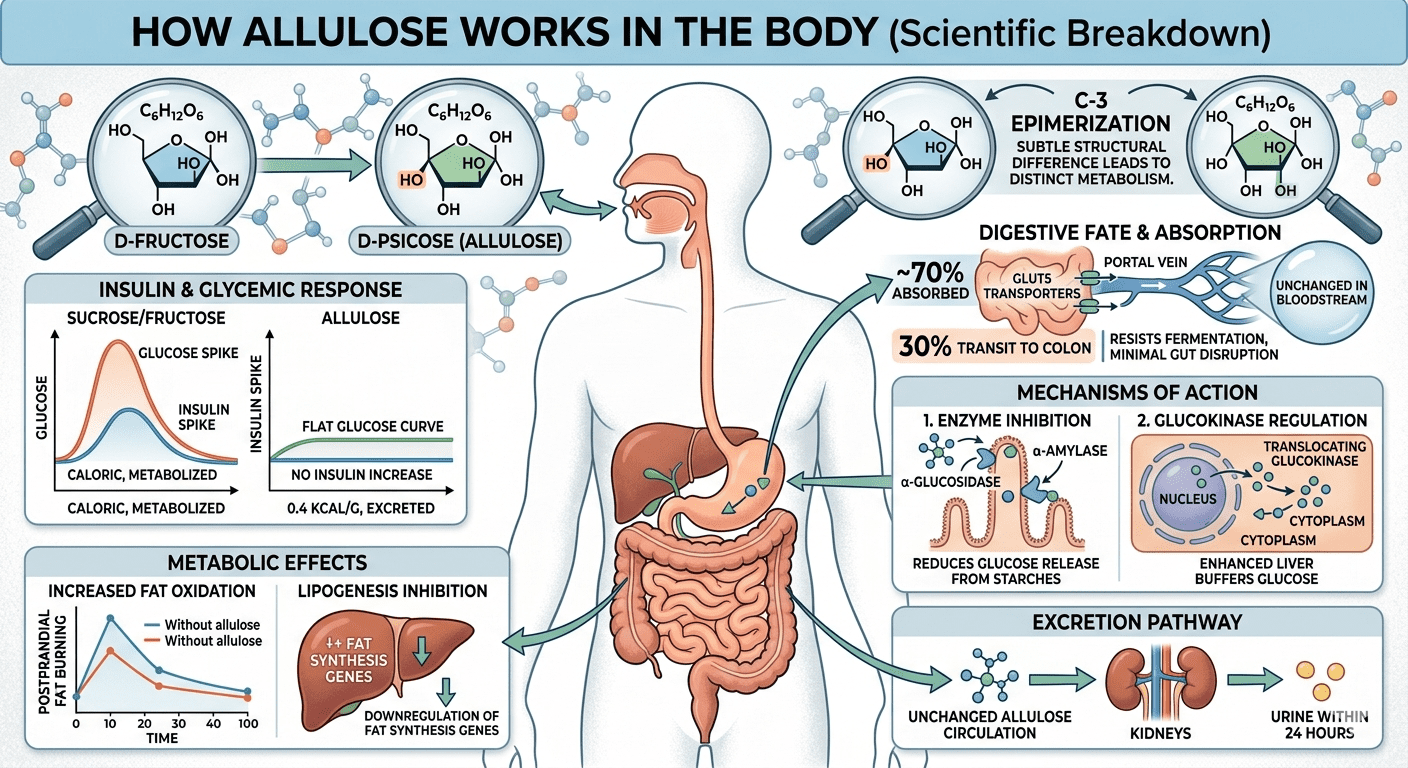
The chemical formula for allulose is $C_6H_{12}O_6$—identical to fructose. However, allulose is a C-3 epimer of fructose. This means the hydroxyl group on the third carbon is mirrored. This tiny spatial difference is profound:
- Taste Receptors: It fits into the T1R2+T1R3 sweetness receptors on the tongue, providing ~70% of the sweetness of table sugar.
- Enzymatic Recognition: Because of the C-3 shift, the digestive enzymes designed to break down carbohydrates (like sucrase) do not recognize allulose as a substrate for energy production.
2. The Absorption and Excretion Cycle
When you consume sucrose, your body works hard to harvest every calorie. Allulose follows a path of “passive transit”:
The 70% Small Intestine Absorption
Approximately 70-80% of ingested allulose is absorbed into the bloodstream via the small intestine. It enters the blood through the GLUT5 transporter. However, once in the blood, the body lacks the metabolic machinery to convert it into glycogen or ATP. Consequently, it circulates freely until it reaches the kidneys, where it is filtered and excreted via urine, typically within 24 hours.
The 30% Colonic Transit
The remaining 20-30% passes into the large intestine. Unlike sugar alcohols (polyols), allulose has shown a remarkable ability to resist fermentation by gut bacteria. This is why users often report significantly fewer gastrointestinal issues compared to erythritol or xylitol.
3. Impact on Glycemia and Insulinemia
One of the most exciting aspects of allulose is its anti-hyperglycemic effect. It doesn’t just “not raise” blood sugar; it may proactively manage it.
| Metric | Sucrose (Table Sugar) | Allulose |
|---|---|---|
| Glycemic Index | 65 | 0 |
| Caloric Density | 4.0 kcal/g | 0.2 – 0.4 kcal/g |
| Insulin Response | High | None |
4. Thermogenesis and Fat Oxidation
Emerging clinical trials have observed that allulose may increase postprandial fat oxidation. In a double-blind study, subjects who consumed allulose before a meal showed a higher rate of energy expenditure and a higher rate of fat burning compared to those who consumed a placebo. This suggests that allulose might play a role in metabolic flexibility, helping the body switch to fat-burning mode more efficiently.
Frequently Asked Questions (FAQ)
Is Allulose safe for Keto and Diabetic diets?
Yes. Because it has a glycemic index of zero and a negligible caloric load, it does not kick a person out of ketosis nor does it require an insulin spike to process.
Does Allulose cause bloating?
While everyone’s gut microbiome is different, allulose is generally much better tolerated than sugar alcohols. Most adults can consume up to 0.5g per kg of body weight without any laxative effects.
Can you bake with Allulose?
Absolutely. It is one of the few sweeteners that undergoes the Maillard reaction, meaning it will brown and caramelize just like real sugar, making it ideal for cookies and cakes.
5. Clinical Study Review: Human Trials (2023–2026)
While early data on allulose was largely derived from murine (rat) models, recent human clinical trials have solidified its standing in human nutrition. A landmark 2024 meta-analysis confirmed that allulose acts as a dose-dependent regulator of postprandial glucose.
The “Fat-Burning” Breakthrough
In a double-blind, randomized controlled trial, researchers monitored the respiratory exchange ratio (RER) of participants. The study found that those who replaced 10g of sucrose with 10g of allulose exhibited a significant shift toward lipid oxidation (fat burning) rather than carbohydrate oxidation. This suggests that allulose may help the body maintain metabolic flexibility even in the presence of a meal.
6. The Biochemistry of Enzyme Inhibition
How does allulose “block” other carbs? The secret lies in its competitive inhibition of specific digestive enzymes. Allulose behaves as a “decoy” for the following:
- α-Glucosidase: This enzyme sits on the brush border of the small intestine. It is responsible for breaking down maltose into glucose. Allulose binds to the active site of α-glucosidase, slowing the release of glucose into the bloodstream.
- α-Amylase: Responsible for breaking down complex starches. Allulose interference ensures that the glucose spike from bread, pasta, or rice is “flattened” rather than peaked.
This “barrier” effect makes allulose a strategic tool for managing the Area Under the Curve (AUC) for glucose levels following a high-carb meal.
7. Impact on the Gut Microbiome and SCFAs
One of the primary concerns with alternative sweeteners is the disruption of the gut flora. However, allulose appears to have a neutral to positive impact on the microbiome.
Current research indicates that allulose may act as a selective prebiotic. While it is not fermented by most “bad” bacteria (which prevents gas and bloating), it can be utilized by certain beneficial strains to produce Short-Chain Fatty Acids (SCFAs) like butyrate. Butyrate is the primary fuel for colonocytes and is essential for maintaining the integrity of the gut barrier (preventing “leaky gut”).
8. The Physics of Allulose: Browning and Texture
In food science, allulose is technically superior to high-intensity sweeteners (like Stevia) because it provides bulk and functionality. It is 70% as sweet as sugar, but 100% as functional in the following ways:
The Maillard Reaction (Browning)
Allulose is a reducing sugar. When heated, it reacts with amino acids to undergo the Maillard reaction. Interestingly, allulose browns faster and at lower temperatures than sucrose. This allows for the creation of keto-friendly baked goods that actually look and smell like traditional pastries.
Hygroscopy and Freezing Point
Allulose is highly hygroscopic, meaning it draws in moisture. This results in “chewier” cookies and softer breads. Additionally, it depresses the freezing point of liquids more effectively than sucrose, which is why allulose is the gold standard for keto ice cream—it prevents the rock-hard crystallization common with erythritol.
Advanced Allulose FAQ
Does allulose break a fast (autophagy)?
Technically, allulose has such a negligible caloric impact (~0.2 kcal/g) that it is unlikely to significantly raise insulin or stop autophagy. Most clinicians consider it “fast-safe” in moderate amounts (under 5–10g).
How does allulose affect the liver specifically?
Unlike fructose, which can contribute to fatty liver when consumed in excess, allulose has been shown in animal models to reduce hepatic fat accumulation by downregulating lipogenic enzymes.
Can pets eat allulose?
While Xylitol is highly toxic to dogs, early studies indicate that allulose does not cause the same toxic insulin surge in canines. However, as it is a newer sweetener, it is always best to keep it away from pets.
Why is it called a “Rare Sugar”?
It is classified as a rare sugar because it is found in nature in very small quantities. Commercially, it is produced through the enzymatic conversion of corn or wheat starch, but the end molecule is identical to the one found in figs.
9. Comparative Biochemistry: Allulose vs. Other Sweeteners
To understand why allulose is disrupting the sweetener market, we must compare its metabolic profile to both bulk sweeteners (sugar alcohols) and high-intensity sweeteners (extracts).
| Sweetener | Mechanism of Sweetness | Digestive Pathway | Metabolic Fate |
|---|---|---|---|
| Allulose | Monosaccharide | Small intestine absorption (70%) | Excreted via urine; no insulin spike. |
| Erythritol | Sugar Alcohol (Polyol) | Small intestine absorption (90%) | Excreted via urine; can cause cooling sensation. |
| Stevia/Monk Fruit | Glycosides/Mogrosides | Bypasses small intestine | Broken down by gut bacteria; zero calories. |
| Sucralose | Organochlorine | Minimal absorption | Mostly excreted in feces; potential microbiome shift. |
Unlike Stevia or Sucralose, allulose provides volume and mass, which affects gastric emptying. Research suggests that bulk sweeteners like allulose can promote a greater sense of satiety (fullness) compared to high-intensity drops or powders.
10. Global Regulatory Status and Safety Dossiers
The safety of allulose is backed by rigorous toxicological data. In the United States, the FDA granted allulose GRAS (Generally Recognized as Safe) status. Crucially, in 2019, the FDA issued a guidance document allowing allulose to be excluded from “Total Sugars” and “Added Sugars” on nutrition labels, though it must still be listed under Total Carbohydrates.
The European and Global Perspective
As of 2026, the **EFSA (European Food Safety Authority)** and **UK Food Standards Agency** have been reviewing allulose under “Novel Food” applications. The delay in some regions is not due to safety concerns, but rather the administrative process of classifying a “rare sugar” that doesn’t fit into the existing “polyol” or “sugar” categories. In contrast, Japan, Mexico, and Singapore have already approved its use, citing its potential to combat rising obesity and diabetes rates.
11. Documented Clinical Outcomes in Human Populations
Rather than theorizing, we can look at the documented results from specific cohorts in clinical settings:
Type 2 Diabetics (T2D)
Clinical trials involving T2D patients show that consuming 5g to 10g of allulose before a carbohydrate-rich meal resulted in a statistically significant reduction in postprandial glucose levels. Researchers noted that the allulose appeared to suppress the glycemic response of the meal itself by inhibiting hepatic glucokinase regulatory protein.
Healthy Adults and Weight Management
In long-term (12-week) studies of healthy adults with a high BMI, the group consuming allulose as a sugar replacement showed a measurable decrease in abdominal fat (visceral fat) compared to the sucrose control group. This is attributed to two factors: the direct caloric deficit and the downregulation of fatty acid synthase in the liver.
Renal Clearance and Safety
Clinical monitoring of renal (kidney) function in humans consuming high doses of allulose has shown no adverse changes in creatinine or glomerular filtration rate (GFR). The kidneys efficiently process the molecule without stress or accumulation.
Conclusion: The Future of Metabolic Health
Allulose represents a paradigm shift in nutrition. It is no longer just about “avoiding sugar”; it is about utilizing rare sugars that provide the sensory experience of sucrose while offering active metabolic benefits. From its ability to inhibit glucose-cleaving enzymes to its role in increasing fat oxidation, allulose is a scientifically validated tool for those seeking to optimize their metabolic health.
As production methods scale and global regulatory hurdles are cleared, allulose is poised to become the primary sugar replacement in both clinical nutrition and the general food supply.