Free shipping on orders over $100


Fresh vs. Frozen vs. Dried Fruit
Posted by William Lang on Sep 23 2026
Fresh vs. Frozen vs. Dried Fruit: What Really Happens to the Carbs?
Fruit has a complicated place in the low-carb world.
On one hand, fruit is a whole food that provides fiber, vitamins, minerals, water, and naturally occurring plant compounds. On the other hand, fruit also contains naturally occurring sugars and carbohydrates, and some varieties can use up a surprisingly large portion of a low-carb or keto carbohydrate budget.
Then things get even more confusing.
Fresh fruit. Frozen fruit. Freeze-dried fruit. Dried fruit.
They can all start with the exact same strawberry, blueberry, apple, mango, or raspberry — yet the nutrition label can look dramatically different.
So does processing the fruit actually change the carbohydrates?
Sometimes the answer is no. But the way those carbohydrates are packaged into a serving can change dramatically.
And that distinction is especially important if you’re trying to eat low carb.
The First Thing to Understand: Carbohydrates Don’t Disappear Because Fruit Loses Water
Let’s start with the simplest concept.
Most fresh fruit contains a tremendous amount of water.
That water contributes weight and volume, but it doesn’t contribute carbohydrates.
When fruit is dried, much of that water is removed.
The carbohydrates that were already present in the fruit don’t simply disappear along with the water.
Instead, you end up with a smaller, lighter, more concentrated piece of fruit.
That’s why comparing fruit by weight can make dried fruit appear dramatically higher in carbohydrates than fresh fruit.
You’re not necessarily looking at fruit that suddenly developed more sugar.
You’re looking at more fruit solids packed into the same weight.
The FDA’s food-labeling guidance recognizes dried fruit as essentially dehydrated whole fruit when no sugar has been added. If sugar is added during processing, that added sugar must be declared separately.
That gives us an important rule:
Removing water concentrates the carbohydrates that were already there.
And that’s where things get interesting for low-carb eating.
Fresh Fruit: The Original Package
Fresh fruit comes with its natural water content intact.
Take a strawberry.
It contains water, carbohydrates, fiber, natural sugars, vitamins, minerals, and other plant compounds. Because so much of the strawberry is water, you can eat a fairly large physical volume of strawberries without consuming an enormous amount of carbohydrate.
The same basic idea applies to many berries.
Fresh fruit tends to have:
- High water content
- Relatively low calorie density
- Natural fiber
- Naturally occurring sugars
- A substantial physical volume for the amount of carbohydrate consumed
This is one reason whole fresh fruit can fit differently into a diet than a concentrated fruit product.
The FDA’s raw-fruit nutrition information, for example, lists a medium banana at about 126 grams with 30 grams of total carbohydrate and an apple at 242 grams with 34 grams of total carbohydrate.
Those numbers aren’t necessarily surprising.
What is important is the amount of food represented by those numbers.
A medium banana is a fairly substantial piece of fruit.
You get water, volume, and the physical act of eating the fruit along with its carbohydrates.
Frozen Fruit: Usually a Different Form, Not a Different Carb Count
Frozen fruit is where things get easier.
If you take strawberries, blueberries, raspberries, or peaches and freeze them without adding other ingredients, freezing itself doesn’t magically turn the carbohydrates into something else.
The fruit is still the same basic food.
The biggest difference is that it has been frozen.
In fact, FDA food categories specifically include fresh and frozen fruits together in the same broad category of fruits.
For someone eating low carb, that means plain frozen fruit can often be treated much like fresh fruit from a carbohydrate perspective.
But there’s a catch.
The serving size still matters.
A bowl of frozen berries can be very easy to eat.
And because frozen fruit is convenient, it can be surprisingly easy to keep adding another handful.
A little more here.
Another spoonful there.
Before you know it, what started as a modest serving has become several servings.
The carbohydrate content of the fruit didn’t change.
Your portion did.
That’s an important distinction.
Freeze-Dried Fruit: Where Things Get Really Interesting
Freeze-dried fruit is different from ordinary frozen fruit.
Freeze-drying removes most of the water from the fruit while the fruit is frozen.
The result is something that is dramatically lighter and more concentrated than the original fruit.
Think about what happens to a strawberry.
A fresh strawberry contains a lot of water.
A freeze-dried strawberry doesn’t.
But the natural carbohydrates that were in that strawberry didn’t simply vanish because the water was removed.
Instead, you now have a crunchy, lightweight piece of fruit containing much less water and therefore much more fruit solids per gram.
This creates one of the biggest problems for someone trying to control carbohydrates:
It’s very easy to eat a lot of freeze-dried fruit without realizing how much original fruit you’re consuming.
Imagine eating several fresh strawberries.
That’s a decent amount of food.
Now imagine those strawberries transformed into tiny crunchy pieces.
You can eat them much faster.
And because they’re lightweight, it can be difficult to judge the portion visually.
That doesn’t necessarily mean freeze-dried fruit is “bad.”
It means the relationship between volume and carbohydrates has changed.
Dried Fruit Has the Same Basic Problem
Raisins are probably the easiest example.
A grape contains a tremendous amount of water.
A raisin is essentially what happens when much of that water is removed.
The raisin is smaller.
It’s lighter.
It’s sweeter tasting.
And it’s much easier to consume a large number of grapes’ worth of fruit in a very small physical volume.
The carbohydrates didn’t need to increase for the food to become much harder to manage on a low-carb diet.
The water disappeared.
That is the key.
The FDA lists dried fruit as a separate food category and specifically identifies foods such as raisins, dates, prunes, peaches, pears, and apples when dried.
And remember: plain dried fruit doesn’t automatically mean added sugar.
If no sugar has been added, the naturally occurring sugars in the fruit aren’t classified as added sugars simply because the fruit was dried.
That’s an important distinction.
So Does Drying Fruit Increase the Carbohydrates?
This is where we need to be precise.
Per piece?
It depends on what happened to the piece during processing.
Per serving?
It depends on how the serving is defined.
Per 100 grams?
Yes, the carbohydrate concentration can become dramatically higher because so much water has been removed.
In the original fruit?
The total carbohydrate in the original fruit hasn’t magically multiplied simply because water was removed.
That’s why nutrition comparisons can become confusing.
Consider this thought experiment.
You start with 100 grams of fresh fruit.
That fruit contains water plus carbohydrates, fiber, vitamins, minerals, and other components.
Now remove most of the water.
You might end up with only a fraction of the original weight.
The carbohydrates that remain are now packed into that smaller amount.
So if you compare:
100 grams fresh fruit
with
100 grams dried fruit
you’re no longer comparing the same amount of original fruit.
You’re comparing a much more concentrated version.
This is why reading the serving size is so important.
The FDA specifically points out that Nutrition Facts values are based on the stated serving size, and eating two servings means consuming twice the listed calories and nutrients.
The Low-Carb Problem: Fruit Can Be Healthy and Still Be High in Carbohydrates
This is one of the most important points for anyone trying to reduce carbohydrates.
“Healthy” and “low carb” are not the same thing.
A food can be nutritious and still contain enough carbohydrate to matter significantly in a low-carb diet.
Fruit is a perfect example.
You don’t have to decide that fruit is “bad.”
You simply have to understand what you’re eating.
For someone following a general balanced diet, an apple or banana may fit comfortably into their day.
For someone trying to stay around a specific carbohydrate target, the same piece of fruit may represent a much larger percentage of their daily allowance.
And for someone following a very low-carbohydrate ketogenic diet, certain fruits may be difficult to fit in regularly.
This is where the conversation becomes less about whether fruit is healthy and more about carbohydrate density and portion control.
Why Berries Are Often Easier to Work With
Not all fruit contains the same amount of carbohydrate.
This is where berries can become particularly useful for people reducing carbohydrates.
Strawberries, raspberries, blackberries, and blueberries all bring different amounts of carbohydrate and fiber to the table.
But berries also have something else going for them:
They provide a lot of physical volume for the carbohydrate they contain.
That can make them easier to portion than something like dried mango, raisins, or dates.
A cup of fresh berries looks like food.
A small amount of dried fruit can represent a surprisingly large amount of the original fruit.
That difference matters.
The Freeze-Dried Fruit Trap
Freeze-dried fruit can be especially tricky because it looks so innocent.
It’s fruit.
It tastes like fruit.
It may have no added sugar.
It can even have a very short ingredient list.
But the water is gone.
That means you can eat the equivalent of a much larger amount of fresh fruit without feeling like you’ve eaten very much.
Think about popcorn.
A giant bowl of popcorn contains a lot of volume because of the way the food is structured.
Now imagine removing most of that volume.
You could fit the same amount of food into a much smaller space.
That’s essentially the problem with dried and freeze-dried fruit.
The food becomes more concentrated.
And concentration is important when you’re counting carbohydrates.
Dried Fruit Can Also Hide Added Sugar
There’s another issue.
Not every dried fruit product contains only fruit.
Some products contain added sugar, syrups, sweeteners, or other ingredients.
That means you cannot assume that every dried fruit product is nutritionally identical to the fruit from which it started.
The ingredient list matters.
The Nutrition Facts panel matters.
And the serving size matters.
The FDA distinguishes naturally occurring sugars from added sugars. Naturally occurring sugars include the sugars found in fruit, while sugars added during processing are declared as added sugars.
So there is a big difference between:
“Dried strawberries”
and
“Strawberries coated with sugar.”
They may look similar sitting on a store shelf, but nutritionally they are not the same product.
Net Carbs Make the Conversation Even More Interesting
For people following a low-carb or keto approach, total carbohydrate isn’t always the only number being watched.
Some people calculate:
Net Carbs = Total Carbohydrate − Dietary Fiber
That calculation can make certain fruits more attractive than others because fiber can reduce the amount of carbohydrate counted toward a person’s chosen net-carb target.
But the same concentration issue still exists.
Drying or freeze-drying doesn’t automatically turn a high-carbohydrate fruit into a low-carb food.
If the carbohydrate is concentrated, you’re still dealing with concentrated carbohydrate.
And serving size remains critical.
A Simple Example
Imagine you start with a large quantity of fresh strawberries.
You remove most of their water.
You haven’t necessarily added sugar.
You haven’t necessarily changed the fundamental carbohydrate composition of the fruit.
But you have created a food that is:
- Smaller
- Lighter
- More concentrated
- Easier to snack on quickly
- Easier to underestimate
- More carbohydrate-dense by weight
That’s the entire issue in a nutshell.
The fruit didn’t necessarily become more sugary.
The water disappeared.
Why This Matters When Making Low-Carb Recipes
This becomes especially important when you’re developing low-carb recipes.
A recipe might call for:
- Fresh strawberries
- Frozen strawberries
- Freeze-dried strawberries
- Strawberry powder
- Dried strawberries
Those ingredients are not interchangeable simply because they all started as strawberries.
The amount of water can dramatically affect the recipe.
Fresh strawberries bring water into the recipe.
Frozen strawberries do too, once they thaw.
Freeze-dried strawberries bring very little water.
Strawberry powder is even more concentrated.
Dried fruit can contribute a concentrated source of natural sugars and carbohydrates.
So when developing a low-carb dessert, you need to think about more than just the ingredient list.
You need to think about:
How much actual fruit is represented by the ingredient?
How much water is present?
How much carbohydrate comes with that fruit?
How large is the finished serving?
This Is One Reason Low-Carb Baking Is Difficult
Traditional baking has an enormous amount of flexibility because sugar and starches perform multiple jobs.
Sugar provides sweetness.
It contributes bulk.
It affects moisture.
It helps with browning.
It influences texture.
It can help preserve foods.
Fruit brings another set of variables.
Fruit contains water.
Fruit contains sugar.
Fruit contains fiber.
Fruit contains acids.
Fruit contains flavor compounds.
And fruit changes dramatically when water is removed.
So when you’re trying to make a dessert lower in carbohydrates, simply removing sugar isn’t always enough.
You have to replace the function that sugar and fruit were providing.
That’s where ingredients such as allulose become interesting.
Why Allulose Can Be Useful in Low-Carb Fruit Recipes
Allulose is particularly useful when you’re trying to create a lower-carbohydrate dessert because it can provide sweetness and some of the functionality that people expect from sugar without relying on traditional sugar.
That can be particularly helpful when you’re working with naturally sweet ingredients such as berries.
Instead of trying to make the fruit itself do all of the sweetening, you can use a lower-carbohydrate sweetener to provide additional sweetness while controlling how much high-carbohydrate fruit goes into the recipe.
This opens up a lot of possibilities.
You can make a berry dessert taste much sweeter without necessarily needing to increase the amount of fruit.
And that’s important because adding more fruit isn’t always the best way to add more fruit flavor.
Sometimes you’re better off using a smaller amount of concentrated fruit for flavor and building the sweetness separately.
Fruit Flavor Doesn’t Always Require a Huge Amount of Fruit
This is one of the most useful concepts in low-carb recipe development.
If you want a strong strawberry flavor, you don’t necessarily need an enormous bowl of strawberries.
You can use fruit strategically.
A small amount of fruit can provide:
- Aroma
- Acidity
- Color
- Natural fruit flavor
- Texture
Then other ingredients can provide:
- Sweetness
- Creaminess
- Bulk
- Structure
This is how you can begin building desserts that taste indulgent without relying entirely on the carbohydrate load of the fruit itself.
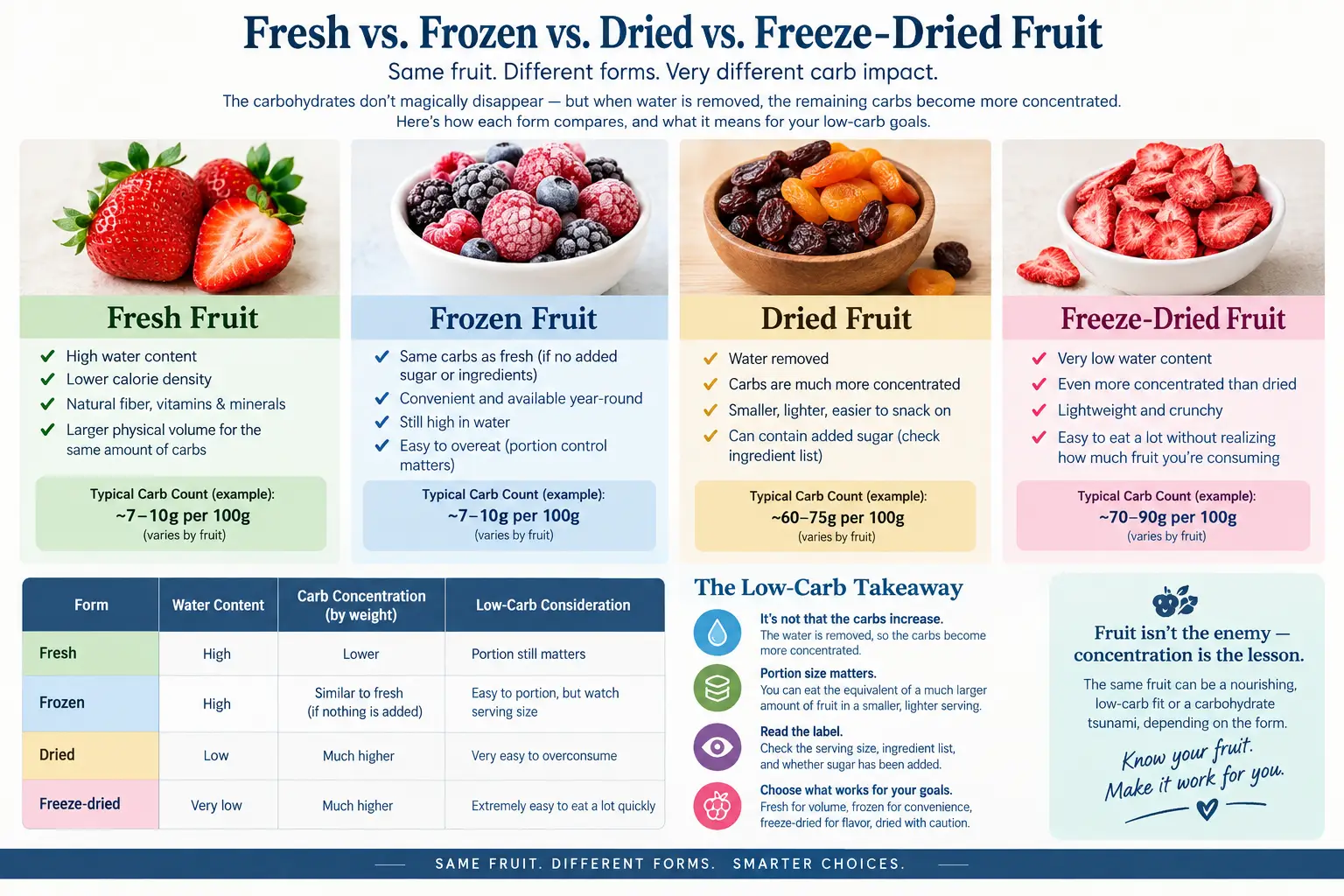
Fresh, Frozen, Dried, and Freeze-Dried: The Big Picture
Here’s the easiest way to think about the four forms.
| Form | Water | Carb concentration by weight | Low-carb consideration |
|---|---|---|---|
| Fresh | High | Lower | Portion still matters |
| Frozen | High | Similar to fresh if nothing is added | Easy to portion, but watch serving size |
| Dried | Low | Much higher | Very easy to overconsume |
| Freeze-dried | Very low | Much higher | Extremely easy to eat a lot quickly |
The important word here is concentration.
The carbohydrate didn’t necessarily appear out of nowhere.
The water left.
The Biggest Mistake: Comparing Equal Weights Instead of Equal Amounts of Fruit
This is where many nutrition comparisons go sideways.
Suppose you compare 100 grams of fresh fruit with 100 grams of dried fruit.
That sounds fair.
But nutritionally, you’re probably not comparing the same amount of fruit.
The dried fruit represents substantially more original fruit because so much of the water has been removed.
A better question is:
How much original fruit am I actually eating?
That’s a much more useful question for someone managing carbohydrates.
The Second Biggest Mistake: Ignoring the Serving Size
The Nutrition Facts panel is built around the serving size.
And the serving size is not necessarily how much you personally are going to eat.
The FDA specifically notes that serving sizes reflect amounts people typically consume and are not recommendations for how much someone should eat.
That’s particularly important with dried fruit.
A package might say:
Serving size: ¼ cup
But if you’re eating directly from the bag, it’s incredibly easy to consume two or three servings.
Suddenly your carbohydrate intake is two or three times what you thought it was.
Does Freezing Make Fruit Lower Carb?
Generally, no.
Freezing isn’t a carbohydrate-removal process.
Plain frozen fruit generally remains nutritionally similar to the fruit before freezing, although exact nutrition can vary by fruit, preparation, and product.
So if you’re looking for a low-carb fruit option, don’t assume that moving it from the produce department to the freezer automatically makes it lower in carbohydrates.
It doesn’t.
What freezing can do is make fruit more convenient, available year-round, and easy to portion.
That’s useful.
But it doesn’t give the fruit a carbohydrate discount.
Does Drying Make Fruit Higher Carb?
Again, this needs a little nuance.
Drying doesn’t necessarily create additional carbohydrate.
But it dramatically increases carbohydrate concentration by weight and by volume.
That’s the part that matters.
A handful of raisins can represent many grapes.
A handful of fresh grapes contains a lot more water and takes up much more physical space.
So you can consume the carbohydrate equivalent of a much larger quantity of fresh fruit in a much smaller amount of dried fruit.
For someone counting carbohydrates, that distinction is enormous.
What About Fruit Powders?
Fruit powders take concentration one step further.
When fruit is dried and ground into a powder, you’ve created an ingredient that can deliver a lot of fruit flavor in a very small quantity.
That can be useful in recipe development.
But again, small physical volume does not automatically mean small carbohydrate contribution.
A teaspoon of a fruit powder may contain very little carbohydrate.
Or it may contain a meaningful amount.
It depends on the fruit, the processing method, the formulation, and the serving size.
That’s why the nutrition label is more useful than simply assuming that something is “just fruit.”
The Low-Carb Takeaway
If you’re trying to reduce carbohydrates, you don’t necessarily need to fear fruit.
But you do need to understand it.
Fresh fruit gives you a lot of water and volume.
Frozen fruit generally keeps much of that same structure.
Dried fruit removes water and concentrates the remaining fruit solids.
Freeze-dried fruit removes even more water and can become incredibly easy to eat in large quantities.
And that brings us to the most important takeaway:
The carbohydrate doesn’t have to change for the food to become much harder to fit into a low-carb diet.
The water changes.
The density changes.
The serving size changes.
The amount you can eat before feeling like you’ve eaten much food changes.
And that’s why two foods that started from the exact same piece of fruit can behave very differently in a low-carb recipe.
So Which Is Best for Low Carb?
There isn’t one universal answer.
It depends on what you’re trying to accomplish.
If you want volume:
Fresh fruit can be useful because the water content provides bulk.
If you want convenience:
Frozen fruit can be an easy option, particularly when there are no added sugars.
If you want intense fruit flavor:
Freeze-dried fruit or fruit powder can provide concentrated flavor, but portions need more attention.
If you’re snacking:
Dried fruit deserves particular attention because it is extremely easy to consume a lot of fruit in a small amount of food.
If you’re making a low-carb dessert:
A small amount of fruit combined with a low-carb sweetener can sometimes provide the flavor you’re looking for without requiring a large amount of high-carbohydrate fruit.
Fruit Isn’t the Enemy — Concentration Is the Lesson
Low-carb eating can sometimes turn into a list of foods you’re “allowed” to eat and foods you’re “not allowed” to eat.
A better approach is understanding why certain foods are easier or harder to fit into your carbohydrate target.
Fruit is a perfect example.
Fresh strawberries and freeze-dried strawberries can come from the same farm.
Fresh blueberries and dried blueberries can start as exactly the same fruit.
Fresh apples and dried apples are still apples.
But once water is removed, the relationship between food volume and carbohydrate changes dramatically.
That’s why a low-carb diet requires a little more attention to portions, preparation, and food concentration.
The goal isn’t necessarily to be afraid of fruit.
The goal is to understand what you’re actually eating.
And once you understand that, you can make much smarter choices about where fruit fits into your recipes, snacks, and desserts.
The Bottom Line
Fresh fruit: Lots of water, lots of volume, naturally occurring carbohydrates.
Frozen fruit: Generally similar carbohydrate content to the fruit before freezing when nothing else is added.
Dried fruit: Water removed, carbohydrates become much more concentrated.
Freeze-dried fruit: Even more water removed, making it extremely easy to consume a large amount of the original fruit in a small, lightweight serving.
For low carb: The biggest issue isn’t necessarily that processing creates more carbohydrates. It’s that removing water makes the carbohydrates much more concentrated and easier to consume.
And when you’re trying to keep carbohydrates low, how much you eat can matter just as much as what form the food takes.
That’s why understanding the difference between fresh, frozen, dried, and freeze-dried fruit can make a surprisingly big difference when you’re building a low-carb kitchen.
{
“@context”: “https://schema.org”,
“@type”: “Article”,
“headline”: “Fresh vs. Frozen vs. Dried vs. Freeze-Dried Fruit: What Really Happens to the Carbs?”,
“description”: “Learn how fresh, frozen, dried, and freeze-dried fruit compare for carbohydrates. Removing water can dramatically concentrate carbs, making portion size especially important for low-carb eating.”,
“image”: “https://langschocolates.com/wp-content/uploads/2026/09/Fresh-vs.-Frozen-vs.-Dried-Fruit.webp”,
“author”: {
“@type”: “Person”,
“name”: “William Lang”
},
“publisher”: {
“@type”: “Organization”,
“name”: “Lang’s Chocolates”,
“url”: “https://langschocolates.com/”
},
“datePublished”: “2026-09-19”,
“dateModified”: “2026-09-19”,
“articleSection”: “Low Carb”,
“keywords”: [
“fresh vs frozen fruit”,
“dried fruit carbs”,
“freeze dried fruit carbs”,
“fruit carbohydrates”,
“low carb fruit”,
“low carb diet”,
“net carbs”,
“dried fruit vs fresh fruit”,
“freeze dried fruit”,
“low carb baking”
]
}